Artificial Intelligence has come a long way from being used primarily for automation and forecasting. As the evolution of AI continues, it is playing a much larger role in software development, helping systems handle tasks that once required significant human involvement. This shift, known as Agentic AI, is changing the way modern software is designed, developed, tested, and deployed.
Today, artificial intelligence developers are no longer only writing static logic. They are building intelligent systems that can reason, adapt, and perform multi-step tasks. This is redefining artificial intelligence software development and creating new career opportunities across industries. The rise of Agentic AI is also reshaping AI software development, making it faster, more autonomous, and highly efficient.
Enroll in our AI Course and build intelligent systems.
Gain hands-on experience under expert guidance.
Enquire Now
What is Agentic AI in Software Development
Agentic AI refers to AI systems that can operate with a goal oriented approach. Instead of waiting for step by step instructions, these systems can break down objectives, plan execution steps, use tools, and self correct based on outcomes.
This is a turning point in the evolution of AI technology because these tools will not be mere helpers but decision makers. In the current technological era, the blend of AI and software development creates agents that work like virtual teammates capable of coding, debugging, documenting, and deploying software.
This shift is driving demand for roles like AI application developer, focused on building intelligent workflows where AI systems can function independently within defined environments.
To get started in this space, many learners begin with a Python Training in Chennai, as Python is widely used in AI frameworks, automation, and backend development for intelligent systems.
How Agentic AI is Changing Software Development
Agentic AI is influencing every stage of the software development lifecycle. From requirement analysis to deployment, intelligent systems are improving speed, accuracy, and scalability.
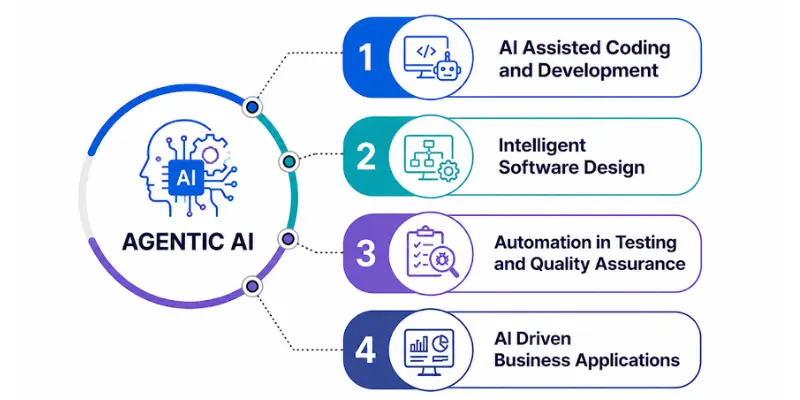
1. AI Assisted Coding and Development
One of the biggest changes is in coding practices. Modern tools powered by AI can generate functions, suggest improvements, detect bugs, and even write entire modules based on prompts.
This is transforming traditional AI software development into a collaborative process between developers and AI systems. Developers now rely heavily on best AI tools to accelerate workflows and reduce repetitive tasks.
AI is also changing AI web development, where websites and applications can be partially generated using intelligent assistants. This reduces development time significantly and improves productivity for both beginners and experienced engineers.
For learners, understanding programming fundamentals through a Python Programming Course becomes essential because most AI driven development tools are built on Python based ecosystems.
“Explore the AI Project Cycle – A Complete Guide and understand how AI systems are built from start to finish!”
2. Intelligent Software Design
Agentic AI is changing the way software architecture is planned and designed. Rather than spending hours creating system blueprints from scratch, developers can use AI powered tools to generate architecture recommendations, map data flows, and suggest user interface structures based on project requirements. This helps teams make informed design decisions faster, streamline the planning process, and focus more on building innovative solutions.
This advancement in AI software design allows teams to rapidly prototype applications and validate ideas faster. AI powered systems analyze requirements and recommend scalable designs, reducing early stage development effort.
Modern AI tools for software development are also capable of evaluating system performance and suggesting improvements in design patterns, making architecture decisions more data driven.
3. Automation in Testing and Quality Assurance
One area where Agentic AI is making a noticeable impact is software testing. AI powered systems can take care of repetitive testing activities, uncover potential issues faster, and provide actionable recommendations to developers.
This is closely aligned with automation practices taught in Playwright Training in Chennai, where learners understand modern testing frameworks and automation workflows.
AI driven testing improves reliability and reduces manual effort in quality assurance teams. It also supports continuous integration and continuous delivery pipelines, making AI software development services more efficient and scalable.
As companies adopt AI powered QA systems, demand for testers skilled in both automation and AI tools is increasing rapidly.
4. AI Driven Business Applications
Enterprises are increasingly integrating AI into business workflows. This includes customer service automation, financial forecasting, HR operations, supply chain optimization, and analytics.
Understanding enterprise systems through a SAP Course in Chennai helps learners connect AI capabilities with real world business processes.
AI systems are becoming central to AI software for business, enabling organizations to automate repetitive operations and focus on strategic decision making. These systems also help reduce operational costs while improving accuracy and scalability.
“Discover the Top Benefits of AI in Digital Marketing and see how AI is transforming the way brands connect with their audience!”
Role of AI in Modern Development Careers
Demand for artificial intelligence developers is rising quickly as more companies shift toward AI-first strategies. Developers are expected to understand not just coding but also how AI systems interact with data, APIs, and cloud infrastructure.
The rise of best AI software development practices is also creating hybrid roles that combine software engineering, machine learning, and data engineering skills.
A strong understanding of data systems is essential, which is why a Data Engineering Course becomes highly relevant. Data Engineering Course in Chennai help professionals build pipelines, manage large datasets, and support AI model training and inference workflows.
“Check out the latest insights on AI Engineer Salary For Freshers and know what to expect when starting your AI career!”
New Technologies in Software Development
The software industry is rapidly evolving with the introduction of advanced technologies that are reshaping traditional development approaches.
Some of the most impactful new technologies in software development include:
- Agentic AI frameworks that can perform tasks autonomously by planning, deciding, and executing steps with minimal human involvement.
- Large language model-powered development platforms that help developers write code, solve problems, and accelerate project delivery
- DevOps and CI/CD platforms that help teams automate builds, testing, and deployments, making software releases faster and more consistent
- Tools that help developers identify issues, understand their causes, and resolve them more efficiently during the development process
- Automated testing solutions that improve software quality while cutting down the effort spent on repetitive testing tasks
- Coding assistants integrated into development environments that provide relevant suggestions, code completions, and productivity support as developers work
- AI-driven cloud optimization solutions that help organizations improve performance, manage resources efficiently, and control costs
- Self-learning software agents that continuously refine their capabilities and adapt to changing requirements over time
These innovations are expanding the capabilities of AI software development services and enabling organizations to build faster, smarter, and more reliable applications.
The growing use of AI tools for software development is cutting down manual effort in repetitive coding work, giving developers more time to focus on problem-solving and system design.
Join our Gen AI Courses and master modern development.
Build powerful AI applications today.
Enquire Now
Future of AI in Software Engineering
The future of software engineering is strongly aligned with intelligent automation. As Agentic AI continues to evolve, developers will transition from writing every line of code to managing and guiding AI-driven systems.
The role of an AI application developer is expected to evolve beyond writing and implementing code. Professionals in this field will spend more time designing intelligent systems, defining workflows, managing interactions between AI-powered tools, and ensuring that the results generated align with business and user requirements.
Businesses using AI are finding new ways to deliver products faster, reduce development bottlenecks, and maintain higher code quality. As AI tools become more capable, they are expected to play an even bigger role in software development.
In the coming years, AI and software development will become deeply integrated, with AI acting as a core component of every development pipeline rather than just a supporting tool.
As this shift continues, professionals skilled in AI-driven workflows, automation tools, and modern development practices are likely to stand out in the job market, and FITA Academy helps you build exactly those capabilities.

