Businesses need reliable financial information to manage expenses, track transactions, prepare reports, and make informed decisions. SAP provides integrated solutions that help organizations handle these activities through a centralized system. SAP financial modules support essential functions such as general ledger accounting, accounts payable, accounts receivable, asset management, and cost control.
Understanding SAP in accounting helps finance professionals and aspiring SAP consultants learn how businesses manage financial operations using enterprise software. These modules also connect financial data with other business functions, making it easier to maintain accurate records and monitor organizational performance. Professionals who want to build their knowledge of SAP modules and business applications can explore the SAP Course in Chennai to understand how SAP is used across different business functions.
What Are SAP Accounting Modules?
SAP accounting modules are components of the SAP ERP system designed to manage an organisation’s financial transactions and accounting activities. They help businesses record income and expenses, maintain financial records, manage payments, and generate reports.
An accounting program SAP provides an integrated environment where financial information can be accessed across different departments. For example, when a company buys raw materials, SAP updates the stock details, supplier accounts, and financial records as part of the same process.
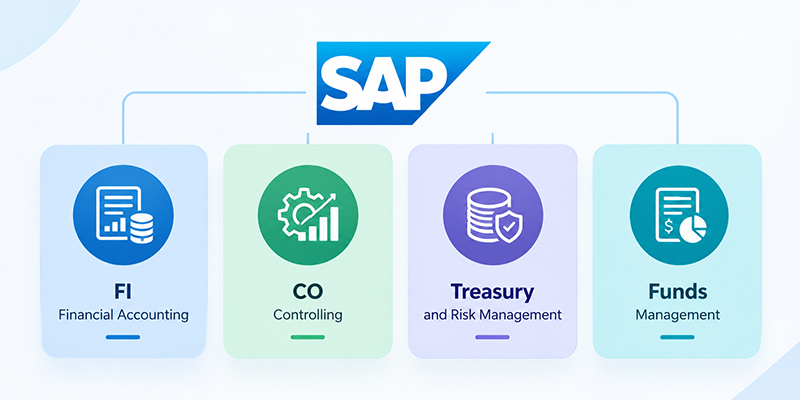
The main accounting components include:
- Financial Accounting (FI): Handles external financial transactions and statutory reporting.
- Controlling (CO): Supports internal cost monitoring, budgeting, and profitability analysis.
- Asset Accounting: Tracks company assets, including their value, depreciation, and related transactions.
- Accounts Payable: Records supplier invoices and tracks payments to vendors.
- Accounts Receivable: Maintains customer billing records and tracks payments received and pending.
These components help organizations maintain consistent financial information and improve coordination between accounting and operational teams.
Different Types of SAP Financial Modules
SAP offers several financial management capabilities to support different accounting and business requirements. Understanding the functions of these SAP financial modules helps learners identify how each component contributes to an organisation’s financial operations.
SAP FI – Financial Accounting
SAP Financial Accounting (FI) manages an organisation’s external accounting activities. It records financial transactions and helps businesses prepare reports for stakeholders, auditors, and regulatory authorities.
The major components include:
- General Ledger Accounting (FI-GL): Maintains the central record of financial transactions and supports balance sheets and profit-and-loss statements.
- Accounts Payable (FI-AP): Manages vendor invoices, payment processing, and outstanding liabilities.
- Accounts Receivable (FI-AR): Handles customer billing, incoming payments, and overdue balances.
- Asset Accounting (FI-AA): Tracks fixed assets, acquisitions, depreciation, and asset disposals.
- Bank Accounting: Records bank transactions and supports reconciliation activities.
- Financial Reporting: Helps generate financial statements and accounting reports.
These functions make SAP FI an essential component for businesses that need accurate financial records and structured reporting processes.
To understand how SAP Financials fits into a broader enterprise resource planning system, explore What Is SAP ERP Software? Features, Benefits & How It Works
SAP CO – Controlling
SAP Controlling (CO) focuses on internal financial management. It helps organizations understand where money is spent, monitor operational costs, and evaluate profitability.
Its major components include:
- Cost Element Accounting: Classifies costs and revenues for internal reporting.
- Cost Center Accounting: Tracks expenses associated with departments and business units.
- Internal Orders: Monitors costs related to specific projects, activities, or assignments.
- Profit Center Accounting: Evaluates the financial performance of different business units.
- Product Cost Controlling: Calculates manufacturing and product-related costs.
- Profitability Analysis (CO-PA): Examines profitability across products, customers, and market segments.
SAP CO helps management teams make informed decisions using detailed cost and profitability information.
SAP Treasury and Risk Management
SAP Treasury and Risk Management supports an organisation’s financial transactions, liquidity planning, and exposure to financial risks. It helps finance teams monitor cash positions and manage treasury-related activities.
Key functions include:
- Cash and liquidity management.
- Financial risk monitoring.
- Debt and investment management.
- Foreign exchange risk management.
- Treasury transaction processing.
These capabilities help businesses manage financial resources and understand potential risks associated with their operations.
SAP Funds Management
SAP Funds Management supports budget planning, allocation, and expenditure monitoring, particularly in public-sector organizations and institutions that operate with defined funding limits.
Its important functions include:
- Budget planning and distribution.
- Fund allocation and tracking.
- Commitment and expenditure monitoring.
- Budget availability control.
- Financial reporting and accountability.
It helps organizations monitor whether spending remains within approved financial limits.
How SAP Financial Accounting Works
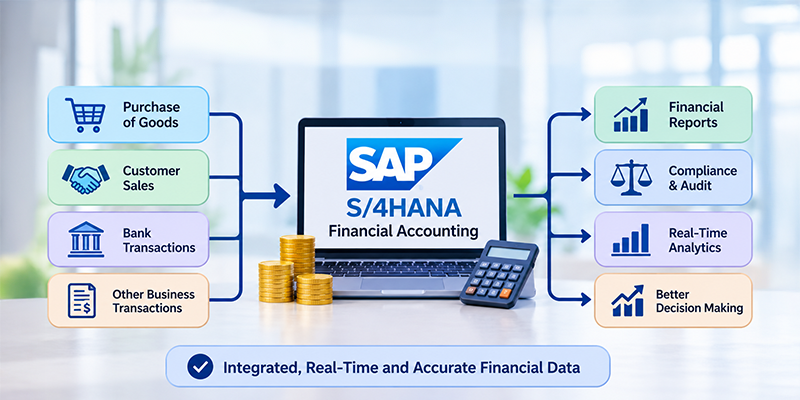
SAP financial accounting follows a structured process for recording, organizing, and reporting financial transactions. Each business transaction creates relevant accounting entries, allowing finance teams to maintain updated financial records. Those interested in understanding how procurement and inventory activities connect with financial processes can explore the SAP MM Course in Chennai.
Here are some common examples of how the system works:
- Vendor Invoice Processing: When a company receives an invoice from a supplier, the transaction is recorded against the appropriate vendor and expense or asset account.
- Customer Payment Management: When customers make payments, the system updates their outstanding balances and records the incoming amount.
- Asset Management: When a business purchases equipment, the asset is recorded and depreciation is calculated according to the applicable accounting rules.
- Expense Tracking: Business expenses are recorded under relevant accounts and can be monitored through financial reports.
- Financial Statement Preparation: Recorded transactions are used to generate balance sheets, profit-and-loss statements, and other financial reports.
These workflows show how SAP connects everyday business transactions with financial reporting and accounting activities.
Go from beginner to job-ready with our SAP MM Training
Enrol NowSAP FI vs SAP CO: Key Differences
SAP FI and SAP CO are closely connected components of SAP Finance, but they serve different business purposes. FI focuses on external financial reporting, while CO supports internal cost management and performance analysis.
|
Comparison |
SAP FI |
SAP CO |
|
Primary purpose |
Financial accounting |
Management accounting |
|
Main focus |
External financial transactions |
Internal cost and profitability analysis |
|
Reporting |
Balance sheets and profit-and-loss statements |
Cost reports and profitability reports |
|
Users |
Accountants and finance teams |
Cost controllers and management teams |
|
Key activities |
Billing, payments, and asset accounting |
Budgeting, cost tracking, and cost allocation |
|
Business benefit |
Accurate financial reporting |
Better cost control and decision-making |
Both components work together to provide a broader view of an organisation’s financial position. For example, an expense recorded through an accounting transaction can also be assigned to a cost centre for internal analysis. Learners interested in developing practical knowledge of financial accounting and controlling can explore SAP FICO Training in Chennai to understand these modules in greater detail.
Key Features of SAP Financial Management
The SAP finance module provides various features that help organizations manage accounting activities and financial information efficiently.
Some important features include:
- Centralized Financial Records: Maintains financial transactions in a structured system and reduces scattered record-keeping.
- Automated Accounting Processes: Supports invoice processing, payment management, and routine accounting activities.
- Real-Time Financial Information: Provides updated financial data for monitoring transactions and business performance.
- Financial Reporting: Helps generate reports required for accounting, management, and compliance purposes.
- Multi-Currency Support: Supports transactions involving different currencies and international business operations.
- Integration with Other SAP Modules: Connects finance with procurement, sales, materials management, and production processes.
- Tax and Compliance Support: Provides functionality to support tax calculations and statutory reporting requirements.
These capabilities help finance teams improve data consistency and manage accounting processes across different business operations.
Go from beginner to job-ready with our SAP ABAP Training
Enquire Now
SAP Financials in SAP S/4HANA
SAP S/4HANA Finance is the financial management solution within SAP S/4HANA. It uses an in-memory database to support faster transaction processing, financial analysis, and reporting. It also introduces changes to the traditional SAP ERP financial architecture.
Some important features of SAP S/4HANA Finance include:
- Universal Journal (ACDOCA): Combines financial and controlling information in a central journal, reducing the need for separate data storage and reconciliation.
- Real-time financial reporting: Provides updated financial information for faster analysis and decision-making.
- Integrated FI and CO: Brings financial and management accounting data together for better visibility.
- Simplified Data Model: Reduces data redundancy and supports more efficient financial processing.
- Improved Analytics: Supports financial analysis through integrated reporting and analytical capabilities.
- Business Process Integration: Connects finance with procurement, sales, inventory, and other enterprise functions.
Businesses adopting SAP S/4HANA can use these capabilities to simplify financial processes and improve access to business information.
As SAP environments increasingly use cloud infrastructure, understanding different cloud platforms can help businesses make informed technology decisions. Explore Which Cloud Service Is The Best: AWS or Microsoft Azure? to learn more about their key differences.
Benefits of Using SAP for Accounting and Finance
Organizations across different industries use SAP to manage financial transactions, maintain accounting records, and monitor business performance. The system offers several benefits for finance and accounting teams.
- Improved Accuracy: Structured transaction recording helps reduce manual errors and maintain consistent financial information.
- Better Financial Visibility: Centralized records allow finance teams to monitor income, expenses, liabilities, and assets.
- Time-Saving Processes: Automated workflows reduce repetitive accounting activities and support faster processing.
- Simplified Reporting: Financial statements and management reports can be generated using recorded business data.
- Effective Cost Management: Controlling functions help businesses monitor departmental expenses and evaluate profitability.
- Business Integration: Financial information connects with other departments, improving coordination between business functions.
- Scalability: SAP supports organizations with multiple business units, currencies, and complex financial requirements.
The integration of SAP in accounting also helps businesses connect financial transactions with operational activities, making it easier to analyze overall performance.
Financial data analysis helps businesses identify trends and make informed decisions. Read Essential Techniques of Data Analytics for Business Success to learn about commonly used analytical methods.
Skills Required to Build a Career in SAP Financials
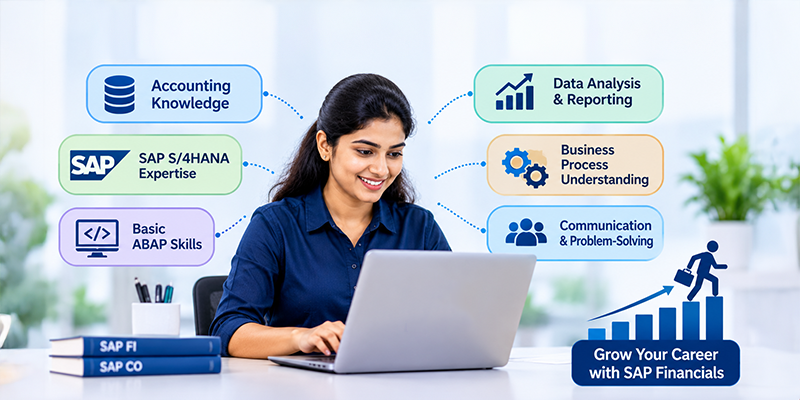
A career in SAP Finance requires an understanding of accounting principles, financial processes, and enterprise software. Learners from commerce, finance, accounting, and related backgrounds can explore this field by developing the following skills:
- Accounting Fundamentals: Understand journal entries, ledgers, balance sheets, and profit-and-loss statements.
- SAP FI Knowledge: Learn general ledger, accounts payable, accounts receivable, and asset accounting.
- SAP CO Knowledge: Understand cost centres, internal orders, product costing, and profitability analysis.
- SAP Configuration: Develop an understanding of organizational structures, master data, and financial settings.
- Financial Reporting: Learn to interpret financial statements and generate business reports.
- S/4HANA Fundamentals: Understand the latest SAP financial processes and the Universal Journal.
- Problem-Solving Skills: Analyze accounting requirements and identify suitable SAP solutions.
Understanding what SAP accounting is and how its components support business operations provides a useful foundation for learners entering this domain. Professionals interested in the technical side of SAP development can also explore SAP ABAP Training in Chennai to learn about SAP programming and customization.
Career Opportunities After Learning SAP Financial Modules
SAP Finance skills are relevant to organizations that use ERP systems for financial operations, accounting, and business management. Professionals with knowledge of financial processes and SAP configuration can explore various career opportunities.
Some common job roles include:
- SAP FICO Consultant: Works with financial accounting and controlling requirements, configuration, and implementation. Learners looking to develop job-oriented skills in SAP financial accounting and controlling can explore SAP FICO Training in Salem for further learning.
- SAP FI Consultant: Works on day-to-day accounting tasks such as maintaining ledgers, processing vendor payments, and tracking customer dues.
- SAP CO Consultant: Handles cost management, budgeting, cost centre accounting, and profitability analysis.
- SAP Functional Consultant: Understands business requirements and helps configure SAP solutions to meet organizational needs.
- SAP S/4HANA Finance Consultant: Works with financial processes and implementation requirements in the S/4HANA environment.
- SAP Financial Analyst: Uses financial data and reports to support business analysis and planning.
The opportunities available depend on a candidate’s accounting knowledge, practical SAP experience, configuration skills, and understanding of business processes.
SAP plays an important role in helping businesses manage accounting, financial reporting, cost control, and other financial activities. Understanding the different SAP financial modules helps learners identify how financial accounting and management accounting work together within an ERP environment. Those interested in learning SAP and understanding its applications across business functions can explore the SAP Course in Coimbatore to build their knowledge of enterprise software
Whether someone wants to understand what is SAP for accounting or develop skills for an SAP Finance career, learning FI, CO, and S/4HANA Finance provides a strong foundation. Practical knowledge of these components can help learners understand real-world financial workflows and explore opportunities in SAP consulting and finance-related roles.
Go from beginner to job-ready with our SAP FICO Training
Enrol Now
