
Artificial intelligence is transforming modern marketing by enabling businesses to automate processes, analyze customer behavior, and enhance the effectiveness of their campaigns. Getting the best results from AI requires a clear plan, reliable data, and well-defined business objectives. This guide covers the main steps for adding AI to your marketing campaigns.
What is AI Marketing?
Artificial intelligence has become an important part of modern marketing, evolving from an emerging trend into a technology that businesses now rely on. Companies in different industries are adopting AI to improve customer insights, streamline routine processes, and support data-driven decision making. With the rapid adoption of generative AI, marketers are transforming how they develop content, execute campaigns, and evaluate performance,solidifying AI’s role at the heart of contemporary marketing strategies.
AI empowers organizations to deliver more relevant and personalized customer experiences while increasing operational efficiency. From optimized email campaigns and intelligent chatbots to predictive analytics and advanced campaign optimization, AI tools are reshaping digital marketing. Professionals looking to understand the latest AI-driven marketing practices can enhance their skills through a Digital Marketing Course in Chennai, where they can learn how AI tools are applied in real-world campaigns. Making the most of AI involves more than simply introducing new technologies into your business. To get the best results from AI, businesses need to start with clear goals, work with accurate and reliable data, and build a structured process that allows AI to fit naturally into their day-to-day operations.
Why Businesses Are Investing in AI
Modern marketing depends heavily on data, as customers interact with brands through websites, search results, social networks, email communication, and mobile applications. Every customer interaction creates useful data, but reviewing and making sense of such large amounts of information manually can take a lot of time and effort. This is one of the key reasons organizations are investing in AI for digital marketing, as it enables them to process information quickly and identify opportunities that might otherwise be overlooked. For example, an ecommerce company can use AI to analyze customer browsing patterns, predict purchase preferences, and recommend relevant products, helping improve customer engagement and increase sales.
The need for more personalized customer experiences is another thing that is pushing adoption. People want brands to know what they’re interested in and send them content that is related to those interests instead of just sending them generic ads. By combining smart automation with customer data, AI and marketing can better target audiences, build stronger relationships with customers, and make marketing efforts more effective.
From automation to personalized customer experiences, AI is opening new possibilities in marketing. Learn what the future holds by reading “How Artificial Intelligence Will Change the Future of Digital Marketing?“
Today’s marketers need to be able to look at customer data and draw useful conclusions from it. Our Data Science Course in Chennai covers analytics, machine learning, and AI-based apps. It’s perfect for professionals who want to learn how to use data to make decisions.
Benefits of Implementing AI in Marketing Campaigns
AI offers several advantages that help businesses improve the way they plan and manage their marketing activities. Businesses can gain the following benefits by integrating AI into their marketing campaigns:
Delivering Personalized Customer Experiences
One of the AI’s key benefits is its ability to create personalized experiences for a large number of customers. AI helps businesses understand customer preferences, browsing habits, and previous purchases, making it easier to suggest suitable products and deliver more relevant email campaigns. For example, many e-commerce platforms use AI to recommend products by analyzing customers’ recent browsing and purchase history. This helps shoppers discover products they are interested in, making their overall shopping experience more engaging. Unique customer experiences help customers feel connected to a brand, leading to their satisfaction, repeat purchases, and long-term customer loyalty.
Personalization can also be used in advertising and customer communication. AI finds groups of people with similar hobbies and sends them ads and deals that are more relevant to them. This way, it doesn’t send the same message to every user. Being more relevant in every contact makes people more interested, builds stronger relationships with customers, and encourages long-term loyalty.
Improving Campaign Performance
Website traffic, customer interactions, email performance, and advertising metrics are all useful tools for modern marketing efforts. This data is analyzed in real time by artificial intelligence marketing solutions, which help marketers figure out which campaigns, audience groups, and content formats work best. Businesses don’t have to make choices based on guesses when they have accurate data.
AI also makes it possible to keep improving campaigns. For example, advertising platforms can change bids automatically, suggest how to spend money, and find campaigns that aren’t working before a lot of money is wasted. This helps businesses get more sales, spend less on marketing, and get a better return on their marketing dollars.
Proper analysis of the data is necessary for marketing decision-making. The Data Analytics Course in Chennai helps marketers learn to collect, process, visualize, and analyze data to spot trends and understand customer behavior. Having knowledge about analytical tools and technologies, marketers can make use of AI-generated data for their benefit and take better-informed decisions.
Increasing Productivity Through Automation
Routine tasks like scheduling posts on social media, organizing customer data, sending follow-up emails, and making campaign reports take a lot of time for people who work in marketing. AI digital marketing tools take care of these boring tasks automatically, so teams can work on strategy, creativity, and customer engagement instead of paperwork.
Automation also makes marketing operations more consistent and efficient. AI can send personalized email sequences, keep customer records up to date, screen leads, and keep an eye on how campaigns are doing without being watched all the time. Businesses can run campaigns faster and more accurately across multiple marketing channels by cutting down on the work that needs to be done by hand.
Creating High Quality Content More Efficiently
Producing valuable content consistently can be challenging, especially when businesses manage multiple digital channels. Digital Marketing AI assists marketers by generating topic ideas, preparing content outlines, suggesting headlines, and creating first drafts that speed up the writing process. Many organizations use AI for marketing to streamline content production while ensuring their teams have more time for research, editing, and strategic planning.
Even though AI makes things more efficient, people are still needed to make original, reliable material. Marketers improve drafts made using AI by adding their knowledge of the industry, checking the facts, and making sure the brand voice stays the same. This mix of AI efficiency and human imagination helps companies create interesting content that connects with their readers and helps them reach their long-term marketing goals.
For individuals who want to develop their writing skills in order to write appealing content that is SEO-friendly, there is a Content Writing Course in Chennai that teaches them all about content planning, copywriting, SEO writing, and content optimization.
Gain Practical Digital Marketing Skills for Real Careers
Enquire Now
How AI is Transforming Different Areas of Digital Marketing
Every aspect of digital marketing is undergoing transformation through the use of AI technology, including the creation of content, customer engagement, optimization of marketing campaigns, and data analysis. AI completes tedious processes and offers deeper insights into customer behavior to marketers. The following sections show how AI is shaping different parts of digital marketing.
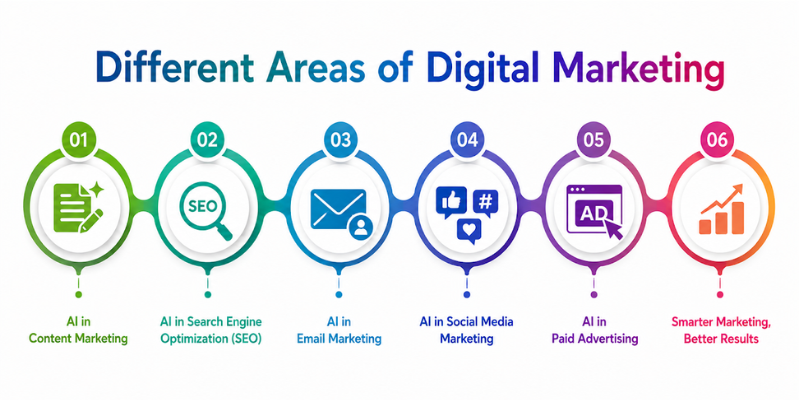
AI in Content Marketing
In content marketing, organizations need to constantly produce informative, helpful, and relevant content. AI technology makes it easier for marketers to discover popular topics, know the interests of their audiences, develop their content strategies, and produce rough drafts. Most of the marketing departments today leverage AI-based tools like ChatGPT or Gemini to think of ideas, create their content plans, and write catchy headlines before passing the material to editors.
AI also evaluates the level of engagement that certain content generates and determines what type of content performs well, thus helping organizations refine their content strategy. As AI speeds up the content generation process, human input is needed to include industry-specific insights, keep the tone of the company intact, and produce quality content.
AI in Search Engine Optimization (SEO)
SEO entails understanding customer intention, identifying search trends, and developing content that is aligned with what customers want. The use of artificial intelligence will assist marketers in finding keyword prospects, analyzing competitor strategies, detecting content gaps, and optimizing the performance of websites through data analysis. For instance, a company in e-commerce that targets “best running shoes” could leverage the use of AI technology to examine the top-ranking web pages, related keywords, and the content gaps to produce more relevant content.
AI in digital marketing also helps track keyword rankings, monitor SEO performance, detect optimization opportunities, and improve existing content based on changing search behavior. With search engines placing greater emphasis on useful and trustworthy content, AI helps businesses create more effective SEO strategies while enabling marketers to improve creativity, accuracy, and overall user experience.
Web traffic analysis and behavioral analytics have equal importance for evaluating the success of SEO initiatives. A Google Analytics Training in Chennai enables people to learn the art of tracking visitor behaviors, analyzing the performance of their websites, and evaluating the effectiveness of marketing campaigns.
AI in Email Marketing
Email campaigns are still widely used to connect with customers, but designing content that attracts a broad audience is not always easy. AI makes this process easier by looking at how customers act, what they buy, and how they interact with your brand to send them personalized emails at the best time. AI helps platforms like Mailchimp and HubSpot suggest subject lines, find the best times to send emails, and divide subscribers into groups based on their hobbies. This helps businesses get more opens and sales.
Email ads are getting more targeted and useful as AI in marketing keeps getting better. AI can also figure out when the best time is to send emails and make content more relevant to each customer based on how they connect with you. Businesses don’t have to send the same message to all of their subscribers. Instead, they can make personalized customer journeys that react to what users do. This leads to more engagement, more sales, and better long-term relationships with customers.
AI in Social Media Marketing
Managing multiple social media platforms requires businesses to create engaging content, interact with audiences, track performance, and adapt strategies regularly. AI helps marketers streamline these activities by identifying trending topics, suggesting content ideas, scheduling posts, and analyzing audience behavior across platforms. For example, a fashion brand launching a new collection can use AI tools to identify popular trends, suggest post ideas, analyze customer reactions, and find the best time to publish content for higher engagement.
AI also helps businesses analyze customer sentiment on social media, evaluate campaign performance, and identify the types of content that generate the best engagement and results.
AI in Paid Advertising
Digital marketing requires the analysis of vast data on the campaign, audience, and market trends, a task that is difficult to do without the aid of AI. Artificial intelligence helps marketers to optimize their marketing campaigns by helping them choose the right audience, changing their bid strategy, improving budget allocation, and estimating the success rate of the advertisements. For instance, an online learning website marketing a digital marketing course can use AI to find out audience groups that are likely to respond to advertisements.
AI for marketing also enables businesses to test multiple ad variations, including headlines, visuals, and targeting options, to determine what works best. By continuously analyzing campaign performance, AI helps marketers refine their advertising strategies, reduce wasted spending, and improve return on investment while making data-driven decisions.
AI-Powered Customer Support
Customer support has become an important part of the overall marketing experience, and AI powered chatbots are helping businesses provide faster assistance around the clock. Many ecommerce companies and service providers use AI chatbots to answer common questions, recommend products, track orders, and guide customers through purchasing decisions before a support representative becomes involved. This improves response times while allowing customer service teams to focus on more complex issues.
Modern AI assistants can also support customers across websites, mobile apps, and social media platforms, creating a consistent experience across multiple channels. Beyond handling customer inquiries, AI also collects valuable insights from customer conversations, helping businesses identify common concerns, improve products, and refine marketing messages. By combining automation with human support, organizations can deliver quicker assistance while creating a smoother and more satisfying customer experience.
Want to understand how performance-driven strategies can transform your marketing results? Check out our blog, “How to Use Performance Marketing to Drive Your Business Growth?”
A Step-by-Step Guide to Implementing AI in Your Marketing Campaigns
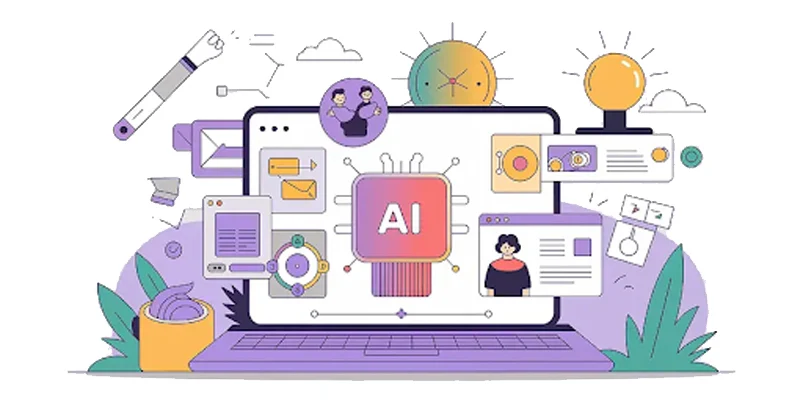
Successfully integrating AI into marketing requires more than choosing the right tools. A structured implementation process helps businesses maximize results, reduce risks, and align AI initiatives with their marketing objectives. The following steps provide a practical roadmap for adopting AI and achieving measurable outcomes.
Define Clear Marketing Goals
No artificial intelligence program can be successful without defined business goals first. It would be wrong for any company to invest in artificial intelligence software without knowing what it wants to do through AI technology. The company may want to attract more visitors to its site or generate qualified leads or anything else.
Having well defined goals also provides a benchmark for evaluating success. Instead of implementing AI simply because it is popular, businesses can focus on solving specific challenges and measuring improvements using meaningful performance metrics.
Build a Strong Data Foundation
AI performs best when it has access to accurate and well organized data. Customer information collected from websites, CRM systems, email campaigns, and social media platforms should be regularly updated and maintained to ensure reliable analysis. Poor quality data can lead to inaccurate predictions and reduce the effectiveness of AI driven marketing strategies.
Businesses should also prioritize responsible data management by complying with privacy regulations and maintaining transparency about how customer information is collected and used. Building trust with customers is just as important as improving marketing performance.
Select the Right AI Marketing Tools
There are numerous AI platforms available, each designed for different marketing activities such as content creation, search engine optimization, email automation, customer relationship management, and campaign analytics. Instead of adopting multiple tools at once, businesses should evaluate their existing marketing processes and identify solutions that address their most immediate needs.
The right technology should integrate smoothly with existing systems while supporting future business growth. Selecting scalable tools allows organizations to expand their AI capabilities without disrupting established workflows.
The AI-enabled CRM tools assist companies in handling their customer interactions, automating follow-up procedures, and providing personalized communication with customers. The individuals who are willing to develop their knowledge about CRM can benefit from Microsoft Dynamics CRM Training in Chennai, where they gain the ability to handle customer information and sales processes using Microsoft Dynamics 365.
Start with Small Campaigns
Implementing AI across every marketing activity at once can make it difficult to evaluate its effectiveness. A better approach is to begin with a single campaign or marketing channel, measure the results, and gradually expand AI adoption based on the insights gained. This reduces risk while allowing marketing teams to become familiar with AI powered workflows.
Testing smaller campaigns also provides opportunities to compare AI assisted strategies with existing methods. By identifying what works best, businesses can make informed decisions before applying AI across larger marketing initiatives.
Train Teams to Use AI Effectively
Successful AI adoption depends on how well marketing teams understand and use these technologies. Businesses should provide training on AI tools, data interpretation, and responsible AI usage to help teams integrate AI effectively into daily workflows.
Monitor Performance and Continuously Improve
AI implementation is an ongoing process rather than a one time project. Marketing teams should regularly monitor key performance indicators such as engagement rates, conversion rates, customer acquisition costs, and return on investment to understand how AI is influencing campaign performance. Continuous evaluation helps identify opportunities for refinement and ensures AI continues to support changing business objectives.
As customer behavior evolves and new technologies emerge, businesses should update their strategies accordingly. This continuous improvement approach allows AI and digital marketing to work together more effectively, helping organizations remain competitive in an increasingly dynamic marketplace.
Common Challenges Businesses Face When Adopting AI
Despite having several benefits, the adoption of AI comes with its own share of difficulties. Some businesses have to face the problem of low-quality data, outdated systems, and insufficient in-house skills, which may affect the performance of AI powered marketing campaigns. Another aspect that needs due consideration is that of integrating AI into current marketing practices.
A different kind of obstacle is to maintain the right balance between automation and creativity. Even though AI will be able to do data analysis and automate the processes, it won’t be able to think strategically, emotionally and narrate. Firms which can use intelligent automation in combination with human knowledge stand better chances of creating an impact.
Businesses also need to consider the accuracy and reliability of AI-generated outputs. AI tools may sometimes provide incorrect information, outdated insights, or recommendations that require human validation. Marketers should review AI-generated content, analyze recommendations carefully, and maintain human oversight to ensure campaigns remain accurate, trustworthy, and aligned with brand goals.
Best Practices for Successful AI Marketing
Adopting AI successfully requires more than implementing the latest technology. Businesses should begin with a clear strategy and use AI to support specific marketing objectives rather than automating every process at once. Starting with smaller campaigns helps teams understand how AI performs, identify areas for improvement, and build confidence before expanding its use across multiple marketing channels.
It is equally important to maintain human oversight throughout the marketing process. While AI can analyze data, generate content, and recommend actions, marketers remain responsible for shaping brand messaging, ensuring accuracy, and making strategic decisions. Combining AI with human creativity produces campaigns that are both efficient and authentic.
From improving developer productivity to automating complex workflows, Agentic AI is opening new possibilities in software engineering. Discover the impact in our blog, “How Agentic AI is Revolutionizing Software Development.”
Focus on Data Privacy and Ethical AI
Customer trust plays a major role in successful marketing, making responsible AI adoption essential. Businesses should be transparent about how customer information is collected and used while complying with applicable privacy regulations. Maintaining secure data management practices not only protects customer information but also strengthens brand credibility over time. For professionals who are keen on learning about customer data security as well as cyber security best practices, they can enhance their knowledge by enrolling in the Cyber Security Course in Salem.
Ethical AI also involves reviewing AI generated content and recommendations before publishing them. Businesses should regularly monitor AI outputs for accuracy, bias, and relevance to ensure that marketing campaigns reflect their values and deliver a positive customer experience.
Continuously Measure and Improve Performance
For AI to work at its best, firms need to consistently analyze the success of campaigns and revise their marketing strategy. With the analysis of website visits, level of engagement, conversion rate, lead quality, and client retention, companies will be able to understand how AI affects their performance.
There is a constant evolution in the world of marketing trends, consumer behavior, and AI technologies. Companies which consistently analyze their campaigns’ performance and modify their marketing strategy will benefit more from their AI investments than those which use static marketing approaches.
Kickstart your AI career with our Artificial Intelligence Course.
Enrol Now
Emerging Trends Shaping the Future of AI in Marketing
The role of AI in marketing is expanding rapidly, introducing new tools and techniques that improve customer engagement, campaign performance, and decision-making. Keeping up with these emerging trends helps businesses stay competitive and make informed marketing decisions in an evolving digital environment.
Generative AI for Content Creation
Businesses are increasingly using Generative AI to streamline the creation of marketing content. From blog articles and email campaigns to product descriptions and advertising copy, AI powered tools help marketers produce high quality content more efficiently. These tools also support brainstorming, content planning, and content repurposing, allowing teams to maintain a consistent publishing schedule while reducing production time. To gain practical expertise in these technologies, explore our Generative AI Course in Chennai.
Even though AI makes creating content easier, originality and expertise still play an important role. Companies that use AI to generate their content drafts and then edit them will have a bigger chance of making content that people can trust and answer their questions.
Predictive Analytics and Customer Insights
One of the most useful uses of AI is predicting the behavior of customers. Using historical data and interactions, AI can find customers who will most probably buy something, who will react to the campaign, and who will stop interacting with a brand. Such information allows the organization to act proactively and not react after the moment when the opportunity was missed.
With the development of predictive analytics, organizations can get better audience segmentation, spend their marketing budget effectively, and create campaigns based on the customers’ intentions, and not on any assumptions.
The use of predictive analytics involves machine learning algorithms which find patterns, make predictions regarding the customer’s actions and help in decision making processes. Those professionals who want to enhance their skills in such an area can get a better understanding of predictive analytics by taking up a Machine Learning Course in Chennai.
Hyper-Personalization Across Marketing Channels
Consumers expect a uniform and personalized experience no matter which means they choose for communicating with a company. AI allows marketers to provide a customized experience on websites, mobile apps, e-mail marketing, social media, and digital marketing ads based on the preferences and activity history of the customer.
The increasing trend of personalization is altering the way companies communicate with their audience. Marketers do not need to make use of audience segments but rather can provide more relevant experiences for better relations with customers.
AI Agents and Intelligent Automation
The next stage of AI and digital marketing involves intelligent assistants that can support marketers throughout the entire campaign lifecycle. These AI powered systems can recommend strategies, monitor campaign performance, generate reports, and automate routine decisions while allowing marketing teams to focus on planning and innovation.
With the advancement of AI capabilities, organizations are likely to embrace intelligent automation that will help them control complicated workflows and even customer engagements while maintaining high standards of their marketing campaigns.
AI Search and Conversational Marketing
With the increase in the prevalence of AI-powered searches, there is an increasing need for content optimization in terms of conversations and user intentions. AI makes it possible for marketers to learn about customers’ search habits and create relevant content.
Marketing is being revolutionized by artificial intelligence in terms of getting to know the customers, automating mundane tasks, and decision-making. The use of AI does not mean replacing marketers but rather means that AI works as a useful ally for marketers in boosting creativity, efficiency, and personalization. With a proper strategy, good data, and adaptability, firms can cope well with the dynamic customer requirements and stay ahead of the game. Get a strong understanding of AI basics through our Artificial Intelligence Course in Erode.
As AI for marketing advances, its influence will go well beyond just automation. Companies that welcome innovation alongside human skill will be positioned to foster deeper customer connections, enhance the effectiveness of their campaigns, and achieve sustainable growth in a digitally competitive environment.
Build job-ready skills with our Generative AI Course.
Enrol Now
