
Every time you check an app for food delivery to get an accurate time for when they will arrive, receive a customized product suggestion, or view a dashboard populating in real time, there is a data engineer somewhere back-ending all these functions. They’re the folks who construct the pipelines, warehouses, and systems that move raw, messy data, make it usable by a business, and build the plumbing of the data world.
Data engineering is one of the most coveted positions in tech, but it’s not receiving the attention it deserves. Data is all around, but when no one is able to, or willing to, organize, clean, and move the data efficiently, it’s just noise. That’s what’s driving demand for the data engineer position every year.
This guide covers what data engineering actually involves, the data engineer skills that matter most in today’s job market, how much you can expect to earn, and the steps you can take to build a career in the field.
What Is Data Engineering?
To put it simply, data engineering meaning can be defined as the branch of computer science dedicated to building systems for collecting, storing, and preparing data to use for analytical purposes. Data engineering comes before data science and analytics since, in order to create a model or a dashboard, one needs to have the data prepared and in place first.
The thing is that in most cases raw data cannot be used in any way. In most organizations, data is collected by the app developers, payment processors, support ticketing systems, etc., each of which keeps data in their own way, updates their databases on their own, and provides occasional corrupted or incomplete data. Hence, one has to create one reliable version of the data, and this process is what data engineering is all about.
With the increasing amount of data coming from various sources, the field has transformed from an auxiliary role into a crucial part of the modern enterprise infrastructure. With the help of data engineering, retailers create systems for managing their inventories in real-time, banks detect fraud in just a few seconds, and streaming services determine what to recommend to their users next.
Go from beginner to job-ready with our Selenium Training
Enrol NowWhat Is a Data Engineer Role in a Modern Data Team?
It’s useful to imagine a data engineer as a plumber of information to get a real understanding of what it means. A water utility doesn’t simply want water to be there; they want the water to be delivered on a reliable schedule to all taps in the city via pipes. A data engineer constructs pipelines for data, which move clean, structured, timely data to the people who need it, whether they’re a machine learning model, a business intelligence dashboard, or a finance team closing the books.
The definition of the data engineer role has changed significantly over the past decade. Previously, it meant someone who was just responsible for transferring data from one database to another. Now, it means a person responsible for building platforms, automation pipelines, cloud data warehouses, streaming solutions, and governance practices that ensure data integrity within an organization. If you want a guided, structured path instead of piecing this together on your own, Data Engineering Training in Chennai can walk you through these concepts with hands-on projects built in.
Here are some day-to-day duties of a data engineer:
- Create scripts to retrieve information from a payments API, a CRM, and a mobile app and then combine the data into a single data set.
- Create and maintain pipelines for data extraction, transformation, loading (ETL), or extraction, transformation, loading (ELT) processes, which are executed on a regular basis
- Produce a data warehouse schema for which the reports do not time out
- Debug pipeline that crashed overnight due to a change in the upstream API format
- Implement data quality controls to flag bad data prior to dashboarding
- Work with data scientists to ensure that the data that drives their models is correct and on time.
It’s a position in which software engineering rigor and knowledge of the downstream use of data converge. Not only are you moving data, but you’re also ensuring that it can be trusted when it arrives.
Data Engineer, Data Scientist, and Data Analyst: Key Differences
It’s important to clarify one point before going any further: this is not a software package. But before proceeding, it’s helpful to clarify one area of confusion: this isn’t a software application. These three roles are frequently confused, but they solve different problems.
Data analysts are involved with data that is already in a usable state. They query it, visualize it, and draw conclusions to answer business questions, skills you can build through Data Analytics Course in Chennai. Data scientists create predictive models and conduct statistical experiments, frequently making use of cleaned datasets to train and test machine learning algorithms. A Data Engineer is the one who lays the groundwork for everyone else. Without it, the data analyst and data scientists would spend most of their time looking for data, rather than analyzing it.
Data science is the art of asking the right questions of the data; data engineering is the art of ensuring the data is available, in the correct format, at the right time, for those questions to be asked.
Step-by-Step Roadmap to Becoming a Data Engineer
There is no one definitive route to getting there. Candidates come from computer science programs, from being analysts, from software engineering, and even from totally different backgrounds via career change. Yet there tends to be a common thread among most data engineers.
1. Build a Foundation in Computer Science and Math
The most typical first step is often a degree in computer science, information systems, engineering, or statistics, primarily because it will provide you with an understanding of how computers actually operate: data structures, algorithms, operating systems, and networking. These basics are more relevant for data engineering than one might think, particularly when optimizing pipelines of millions of records.
However, it’s not required. Many people end up being a data engineer without one if they work hard to learn the technical aspects by themselves.
2. Learn SQL Before Anything Else
If you have only one skill to learn before you go to work, it’s SQL. Almost all of your data engineering tasks will eventually involve a database, and SQL is the language you will use to query, filter, join, and transform your database data. Familiarise yourself with window functions, indexing, and query optimization, and understand how databases process queries beyond the SELECT statement.
If you’re just starting out,SQL For Data Science: For Beginners is a good place to build this foundation before moving on to more advanced query optimization techniques.
3. Pick Up a Core Programming Language
Python is the language of choice for data engineering as a result of its readability and vast library of tools, including Pandas for data manipulation, SQLAlchemy for database connections and PySpark for distributed processing. In environments that are based on the Hadoop/Spark ecosystem, some teams also rely on Java or Scala, as these have native support on the JVM. Start by learning one language thoroughly, and then move on to three.
4. Understand Databases Deeply, Both SQL and NoSQL
Understanding relational databases, how they are structured, indexed and normalised, and when they do not work will be important. Some data (logs, user sessions, unstructured documents) doesn’t fit neatly into rows and columns which is why there are NoSQL databases like MongoDB or Cassandra. To become a successful data engineer, one must be aware of when to use what tool rather than putting all the problems in a single box.
5. Get Practical With Big Data and Streaming Tools
Distributed processing frameworks are needed when the data sets become larger than what can be processed by a single machine. Apache Kafka has emerged as the backbone of live data pipelines, such as those for fraud prevention or recommendation engines, which don’t have time for a nightly batch job, while Apache Spark is the industry’s go-to for batch and stream processing at scale. Learning these tools, however, doesn’t have to be a mandatory part of your first job, but it does indicate that you are thinking at scale. Python Training in Chennai pairs well with this step, since most Spark and streaming work in the real world is written in Python.
6. Learn Cloud Platforms
Today, almost no company has any data systems running on all its own servers. AWS, Google Cloud Platform, and Microsoft Azure all have sets of data engineering services available, including AWS Glue and Redshift, Google BigQuery and Dataflow, or Azure Data Factory and Synapse. It doesn’t matter if you don’t necessarily need to know all three, but if you know a single cloud ecosystem well, the concepts apply easily to the others. AWS Training in Chennai is a strong starting point if you are unsure which cloud provider to focus on first.
Since data pipelines increasingly get deployed and monitored the same way applications do, it’s worth understanding AWS DevOps Tools and Processes Needed to Develop a Web App, even if your day-to-day work stays focused on data rather than app development.
7. Practice With Real Projects
While reading about pipelines can be very different from building one. Select a public data source like flight delays, weather data, public transportation feeds, etc., and create a full pipeline: ingest the data, clean it, transform it, load the data into a data warehouse, and visualize the data. It’s the quickest way to make concepts go from theory to fact and it provides you with something to present in interviews.
8. Build a Portfolio and Get Real-World Exposure
A different kind of certificate, like an internship or a freelance project or even a contribution to an open-source data tool, may be more important than another certificate on your resume. Employers are looking for evidence of your experience working with messy, real-world data, rather than textbook examples.
9. Apply, Iterate, and Keep Learning
Begin with junior positions like Junior Data Engineer or Data Engineer I, or even related positions like Database Administrator or Analytics Engineer if a data engineering opening is not available. The world of the field is constantly evolving, so continuous learning should be seen as a part of the job, not an afterthought after you receive your first offer.
Build in-demand skills with our Python Training
Enquire Now
Core Data Engineer Skills Employers Look For
The job posting for a data engineer may seem overwhelming due to the long list of tools that they require in the same breath. However, the truth is that the majority of jobs actually have only a few skills in mind.
Programming and Scripting – Proficiency with Python (or Java/Scala), which will help in developing pipelines and automation scripts for the job. If you’re based nearby, a Python Course in Salem is a convenient way to build this scripting foundation with local, in-person support.
SQL and Database Design – Being familiar with query optimization, database schema design, indexing, and knowledge of transactions just enough to avoid problems with data integrity.
Data Warehousing – Understanding the principles behind warehousing, like the star or snowflake schemas, as well as hands-on experience with tools such as Snowflake, BigQuery, and Redshift that allow quick querying of large amounts of data.
ETL and ELT Development – The ability to create pipelines for data extraction from sources, transformation into the necessary format, and loading it into storage using tools such as Apache Airflow, dbt, and Fivetran.
Distributed Computing – Knowing how Spark/Hadoop works in terms of distribution across multiple machines, since there’s no way a single server can process terabytes of data in a timely manner.
Streaming and Live Data Processing – Knowledge of technologies like Kafka, Kinesis, or Pub/Sub for creating systems that process data as soon as it comes in, instead of processing batches.
Cloud Infrastructure – Familiarity with the data stack offered by at least one major cloud vendor and basic infrastructure-as-code practices, such as Terraform, because data infrastructures now reside in the cloud, not in a firm’s own data center.
Data Modeling – Creating a data model so downstream users can efficiently access data and won’t have to battle with a badly designed schema.
Version Control and Deployment Basics – Knowing Git is a must nowadays, and also being familiar with some basic deployment practices, so the changes made don’t silently break the system.
As you may see, these skills for data engineers strongly overlap from company to company, and this is great news – because learning these core skills will give you employment opportunities almost anywhere.
Soft Skills That Set Great Data Engineers Apart
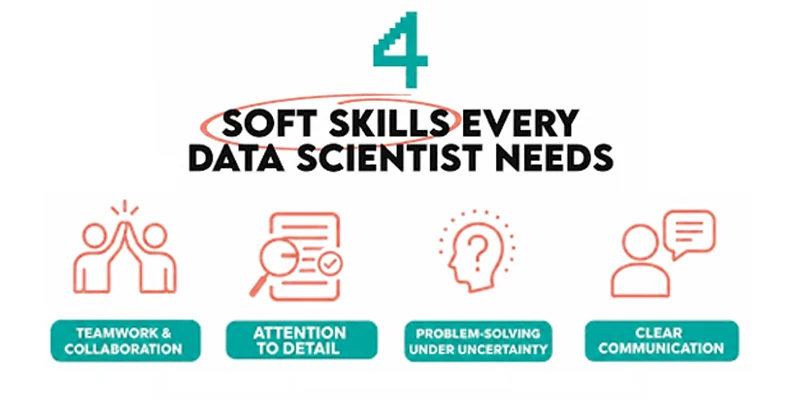
Technical ability gets you in the door, but soft skills decide how far you go. A few stand out.
Problem-solving under uncertainty. Pipeline failures happen in surprising ways – the upstream schema gets changed out of nowhere, a job crashes without anyone noticing during the night shift, or a data source starts sending duplicates for no obvious reason. The ability to solve these issues in a calm manner is as much of an asset as the ability to write clean code.
Clear communication. There will be a lot of times when you will have to convey to a nontechnical stakeholder why the report is late, or argue with a product team that a “simple” data query cannot be done in just a few days. Communicating the constraints in layman’s terms helps to build trust.
Collaboration. Data engineers occupy an interesting position where software engineering, analytics, and business strategy intersect. They constantly talk to data scientists, analysts, and product managers, and that is why good collaboration skills come in handy.
Attention to detail. A wrong data type or one null value could silently destroy an entire report downstream. Experienced engineers learn to always check their assumptions before pushing code.
Once you’re comfortable with the basics, it helps to go deeper into object oriented concepts like Types Of Inheritance In Python, since well structured, reusable code becomes essential once your pipelines grow beyond a handful of scripts.
Data Engineer Salary Insights
As far as the salary range is concerned, for a data engineer, it usually stands slightly above the median level of software engineers, which is explained by the fact that this position requires a more niche skill set.
In the United States, salaries differ greatly, depending on the experience, location, and scale of the company – engineers working for big tech companies have high salaries in most cases. In Europe, the situation depends on the country – salaries in Germany, the Netherlands, or the UK are usually higher than the regional average, while new tech hubs of Eastern Europe catch up fast. In India or Asia in general, salaries for the data engineer position have skyrocketed over the last few years, especially in companies that have international customers or analytics departments. They are several times higher than entry-level salaries.
It should be noted that since salaries depend on market conditions, it would be better to check the latest data in salary aggregators like Glassdoor, Levels.fyi, or Payscale, rather than in any one source, as it changes much faster than articles.
Do Certifications Actually Help?
Certifications will not replace practical experience, but they do serve a real purpose, especially early in your career.
They give you a structured way to learn a specific tool or platform instead of piecing together scattered tutorials. They signal to recruiters that you have validated your skills against an external standard, which matters when you do not yet have a work history to point to. Cloud certifications in particular, such as AWS Course in Pondicherry, Google Cloud Professional Data Engineer, or Microsoft’s Azure Data Engineer Associate, are often explicitly listed as preferred qualifications in job postings, since they prove you can work within that specific ecosystem. They can occasionally support a salary negotiation too, since they demonstrate commitment beyond the minimum requirements of the job.
Treat certifications as a supplement to real projects, not a substitute for them. A hiring manager will almost always be more interested in a pipeline you built and can explain in detail than a certificate you passed after a weekend of practice tests.
Common Mistakes Beginners Make
A few patterns show up again and again among people trying to break into this field.
- Learning tools without learning fundamentals. Jumping straight into Spark or Airflow without a solid grip on SQL and data structures leads to shallow understanding. You can follow a tutorial but cannot debug when something breaks.
- Skipping the reasoning behind pipelines. It is easy to copy a pipeline architecture from a course without understanding why each step exists. Interviewers can usually tell the difference between someone who built something and someone who just followed instructions.
- Ignoring data quality and testing. Beginners often focus entirely on moving data and forget to validate it. Pipelines fail in the real world because nobody checked for null values, duplicate records, or unexpected schema changes.
- Trying to learn every tool at once. The data engineering toolset is enormous, and chasing every new framework leads to shallow knowledge across the board. Depth in a smaller stack beats surface familiarity with everything.
- Underestimating the job search timeline. Building genuine competence takes months, not weeks. Rushing the process often means applying before you are ready and getting discouraged by early rejections.
Typical Career Progression
Data engineering careers tend to follow a fairly predictable arc, even though the pace varies a lot from person to person.
Junior or Associate Data Engineer (0 to 2 years): During this time frame, you’ll be working on clear-cut tasks on an existing pipeline, fixing bugs, doing small ETL jobs, or working on dashboards that someone else has built for you. Here, your objective will be to get fast and become confident with the toolkit under the supervision of senior colleagues.
Data Engineer (2 to 5 years): Here you will own the end-to-end pipelines, make architectural decisions, and become independent in stakeholder interactions. Specialization starts taking place at this level as some people become more interested in working on streaming systems while others focus on warehouse design or platforming.
Senior Data Engineer (5 to 8 years): At this level, senior data engineers are expected to design scalable systems, guide junior team members, and influence decision-making on tools that can affect the whole data engineering team.
Staff, Lead Data Engineer, or Data Architect (8+ years): At the top of the technical track, the focus shifts toward data strategy over several years: deciding how an organization’s entire data platform should be structured, evaluated, and evolved. Some engineers move into management instead, leading data engineering teams rather than building pipelines themselves.
There is no single right path here. Some engineers happily stay hands-on for their entire careers, while others move into architecture, management, or product roles that build on their data background. What matters is that the field offers genuine room to grow in more than one direction.
Retail is one of the clearest examples of this in action; these Big Data Use Cases for Retail show how the same distributed processing skills you’re building can power real-time inventory tracking and personalized recommendations.
The Future of Data Engineering
The role is evolving quickly, and a few trends are worth watching if you are planning a long career here.Rising demand across every industry. Not only is the tech sector employing data engineers. Other industries such as retail, health care, banking, and manufacturing are building data teams as they become even more analytics- and automation-oriented.
Convergence with machine learning infrastructure. With more companies introducing AI components in their product offering, a data engineer will be working with the ML engineers on the creation of the feature pipeline and data infrastructure for the models.
Growing focus on data governance. Data privacy and compliance due to regulations like GDPR are becoming a first-class concern rather than an afterthought. A data engineer is the person who implements the necessary systems and keeps organizations compliant.
The rise of the modern data stack. The development of technologies such as dbt, Snowflake, and Fivetran leads to a shift of the transformation logic from code to SQL, which is changing the skill set a little bit towards analytics engineering hybrids.
More specialization. As the field matures, roles are starting to split into more specific tracks: some engineers focus on live streaming systems, others on data platform architecture, and others on data quality and governance.
None of this makes the fundamentals obsolete. If anything, a solid grip on SQL, data modeling, and distributed systems will keep paying off no matter which specific tools rise or fall in popularity over the next few years.
Getting Started on Your Data Engineering Journey
Becoming a data engineer is not about checking all the tools. This is about having the actual skills to move, structure and protect the data. Begin with the basics – SQL, programming languages, and database management systems. Once you understand these well, add cloud and big data tools. Make projects, even small ones, as they give more knowledge than any course ever could. Also, when working in this sphere, think of learning as a part of your work instead of another thing that needs to be checked off the list.
The demand for data engineers is going nowhere and becoming one is definitely possible. It might not be easy, but still possible. If you do everything in a practical and steady way, there is definitely a road for you to get there.
Master real-world pipelines with our Data Engineering Course.
Enrol Now
