As more businesses turn to cloud computing and automation, the need for skilled DevOps professionals is growing. Companies in many fields are using DevOps to improve teamwork, deliver software faster, and make their systems more reliable. This means employers want people with real experience using DevOps tools and methods.
The DevOps Training in OMR at FITA Academy helps learners gain practical experience with popular tools and technologies. If you are looking for the Best DevOps Training in OMR, this course helps you build the technical skills that companies look for today. You will also learn how DevOps is used in software development, cloud systems, and deployment.
Placement Support
Along with technical training, FITA Academy provides structured placement support to help you prepare for job searches. You will get help with writing your resume, practicing interviews through mock sessions, and learning about common technical interview questions. Career guidance sessions explain what employers expect and help you get ready for each step of the hiring process. Students looking for the Best DevOps Coaching in OMR can benefit from practical training, placement guidance, interview preparation, and career support throughout the hiring process.
“100% placement assistance is provided to our students until they land their dream job.”
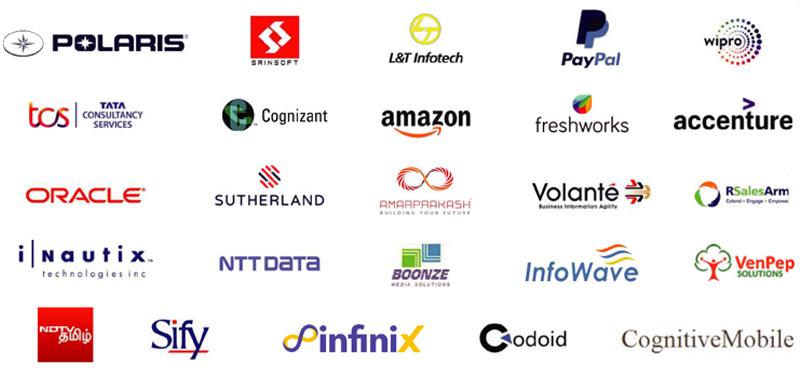
Professionals who have chosen to make a career in DevOps have lots of opportunities across industries. From software development companies and IT firms to product-based companies, startups, cloud consulting firms, and digital transformation companies, DevOps Engineers are in demand. Moreover, reputed companies like TCS, Infosys, Cognizant, HCLTech, Wipro, Capgemini, Accenture, IBM, AWS, and Tech Mahindra also recruit DevOps Engineers at various levels.
Devops Engineer salary for freshers ranges between INR 3.5 – 5.5 LPA. This may vary depending on the technical and interpersonal skills, certifications, location, and the company they get employed with. With 3 to 5 years of experience working with AWS, Azure, Docker, Kubernetes, Jenkins, Terraform, Git, and CI/CD Tools, one can earn a salary between INR 7 – 12 LPA.
After finishing a DevOps course, you can explore different career paths, such as:
DevOps Engineer
The role involves automating routine tasks, managing deployment pipelines, supporting application releases, and maintaining infrastructure across development, testing, and production environments. They also monitor application performance, troubleshoot deployment issues, and help improve system stability.
Specialists in this role commonly work with Linux, Git, Jenkins, Docker, Kubernetes, Ansible, Terraform, Python, and Leading cloud platforms, including AWS, Azure, and Google Cloud. Knowledge of scripting languages, CI/CD practices, automation, and troubleshooting is highly valued. DevOps Engineers are in demand among software companies, product-based firms, cloud service providers, banks, tech startups, and financial institutions.
Cloud DevOps Engineer
This role requires experience with leading cloud platforms such as AWS, Microsoft Azure, or Google Cloud Platform, along with tools like Terraform, Docker, Kubernetes, Jenkins, and Ansible. Understanding cloud networking, security, container orchestration, and Infrastructure as Code (IaC) is important. Cloud DevOps Engineers are commonly employed by SaaS companies, cloud consulting firms, fintech organizations, healthcare technology companies, and enterprises migrating workloads to the cloud.
Build and Release Engineer
A Build and Release Engineer supports the process of building, Software Testing, packaging, and deploying software applications. They ensure that every software release moves smoothly through different environments while minimizing deployment errors. Their key responsibilities include maintaining build pipelines, planning software releases, and resolving build issues.
These professionals frequently use Jenkins, GitHub Actions, GitLab CI, Maven, Gradle, Docker, and version control systems such as Git. Build and Release Engineers work in software development companies, enterprise IT departments, product companies, and organizations that follow Agile and DevOps methodologies.
Site Reliability Engineer (SRE)
Site Reliability Engineers focus on maintaining the reliability, availability, and performance of applications and infrastructure. Their day-to-day work includes monitoring production environments, responding to incidents, improving system performance, and automating operational tasks that reduce manual effort.
SRE professionals use technologies such as Prometheus, Grafana, Kubernetes, Docker, Linux, Elasticsearch, and cloud monitoring platforms. Knowledge of Data Analytics can also help them analyze system metrics, logs, and performance trends to identify issues and support operational decisions. Strong analytical thinking, scripting knowledge, and experience with distributed systems are valuable in this role. Career opportunities are available in e-commerce companies, banking and financial institutions, cloud-native businesses, media platforms, and large technology enterprises.
DevOps Consultant
A DevOps Consultant guides businesses to improve software delivery by evaluating the processes and recommending efficient DevOps strategies. They analyze infrastructure, identify automation opportunities, guide cloud adoption, and help development teams to implement DevOps practices that improve operational efficiency.
The role involves working with CI/CD platforms, cloud services, Infrastructure as Code tools, monitoring solutions, container technologies, and configuration management platforms. In addition to technical expertise, strong communication, documentation, and collaboration skills are important because consultants regularly interact with stakeholders and technical teams. DevOps Consultants are hired by IT consulting firms, managed service providers, digital transformation companies, cloud solution providers, and large enterprise organizations.